Hazard Identification and Risk Assessment in Industrial Construction
Industrial construction sites are dynamic environments where risks can change rapidly as projects progress. Identifying hazards early and evaluating their potential impact is essential for preventing accidents and ensuring safe working conditions.
Hazard identification and risk assessment are structured processes that allow project teams to anticipate risks, prioritize safety measures, and implement effective controls
Understanding Construction Hazards
Hazards can originate from multiple sources across construction sites.
Common examples include:
– Moving machinery and mechanical equipment
– Electrical systems and exposed wiring
– Excavation activities and soil instability
– Confined spaces with limited ventilation
– Heavy lifting and material handling
Regular site walkthroughs and inspections help identify these hazards before they lead to incidents.
Conducting Risk Assessments
Once hazards are identified, the next step is evaluating their risk level. This is typically done using a risk matrix that considers two factors:
- Likelihood of occurrence
- Severity of consequences
Based on these factors, risks can be categorized as low, medium, high, or critical. High-risk activities require immediate attention and additional safety measures.
Applying the Hierarchy of Controls
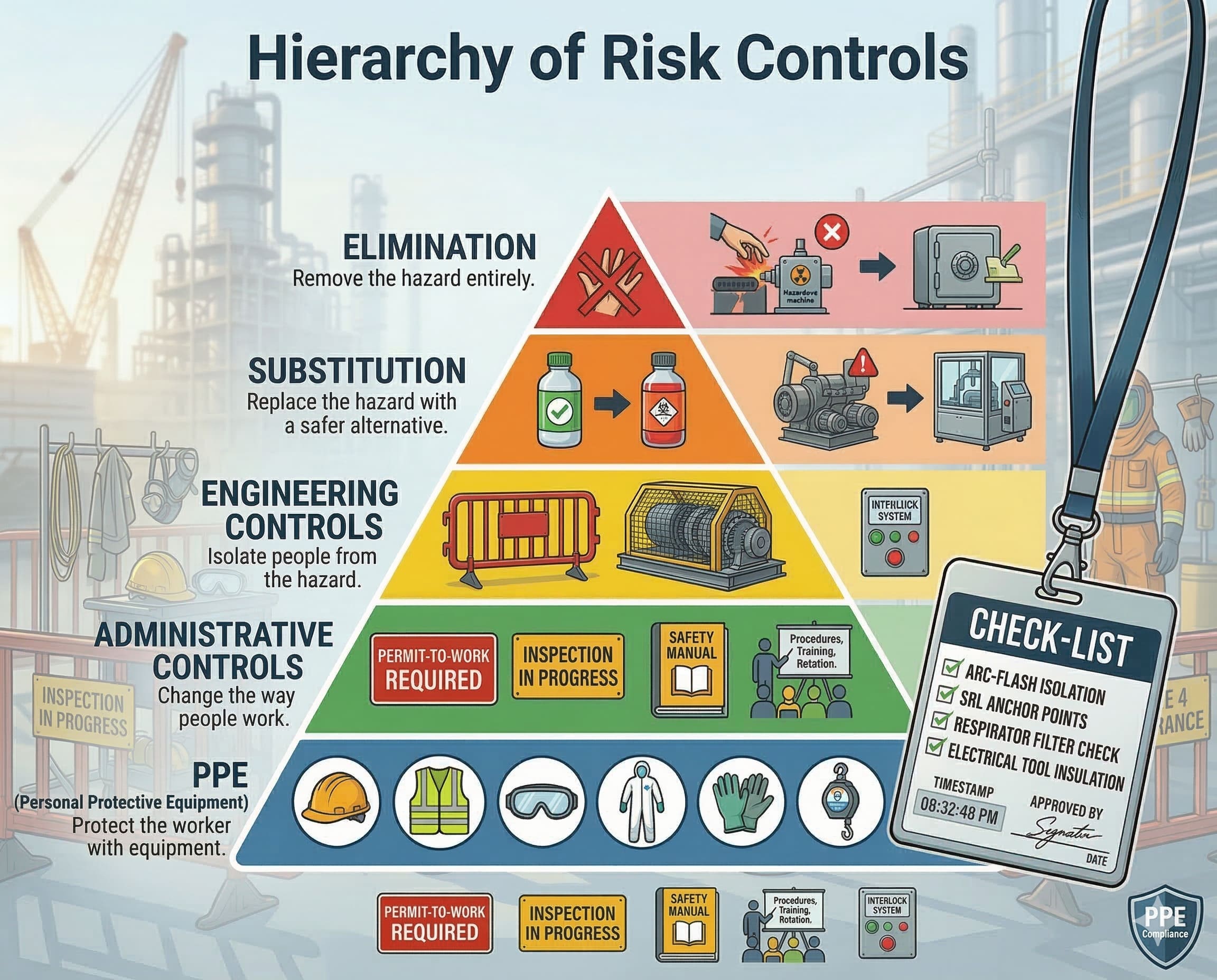
To effectively manage risks, construction projects follow the hierarchy of controls, which prioritizes risk reduction strategies.
The hierarchy includes:
- Elimination – Removing the hazard entirely
- Substitution – Replacing hazardous materials or methods with safer alternatives
- Engineering Controls – Implementing physical solutions such as barriers or ventilation
- Administrative Controls – Developing procedures, training, and supervision
- Personal Protective Equipment (PPE) – Protecting workers when other controls cannot eliminate risks
Using this structured approach ensures safety solutions address the root cause rather than simply managing symptoms.
Work Permit Systems for High-Risk Activities
Many industrial construction activities require formal work permits to ensure proper safety procedures are followed.
Typical permits include:
- Hot work permits for welding or cutting
- Confined space entry permits
- Electrical isolation permits
- Excavation permits
Each permit must be authorized by a competent supervisor and displayed at the work location.
Continuous Risk Monitoring
Construction sites evolve continuously as new structures, equipment, and processes are introduced. Risk assessments must therefore be updated regularly.
Changes such as new machinery installations, weather conditions, or modified work schedules can introduce new hazards.
Maintaining continuous monitoring ensures safety measures remain effective throughout the project.